Showing posts with label FMQ. Show all posts

Tuesday, February 18, 2014

Butterfly quilt, a new way to applique


Miss Abagail loves purple and butterflies.  The quilt was quilted first without the butterflies appliqued on to it.  That kept the feathers pattern going under the feathers instead of along side of them.  It also made it easier to quilt.   After the intertwining feathers were quilted, the butterflies were fused onto the top.  The bottom one hangs over the edge of the binding and is backed with regular fabric.  The bottom half is not stitched down.  The other butterflies go from big to small as they go to the top of the quilt.  The top butterflies are cut out of a fabric print.  Quilting was also used to decorate the butterfly wings.

The small purple border was taken from the backing fabric.  After the quilt was squared up, the backing fabric cut off was used for the binding.

Sunday, January 26, 2014

Blue Delph Quilt

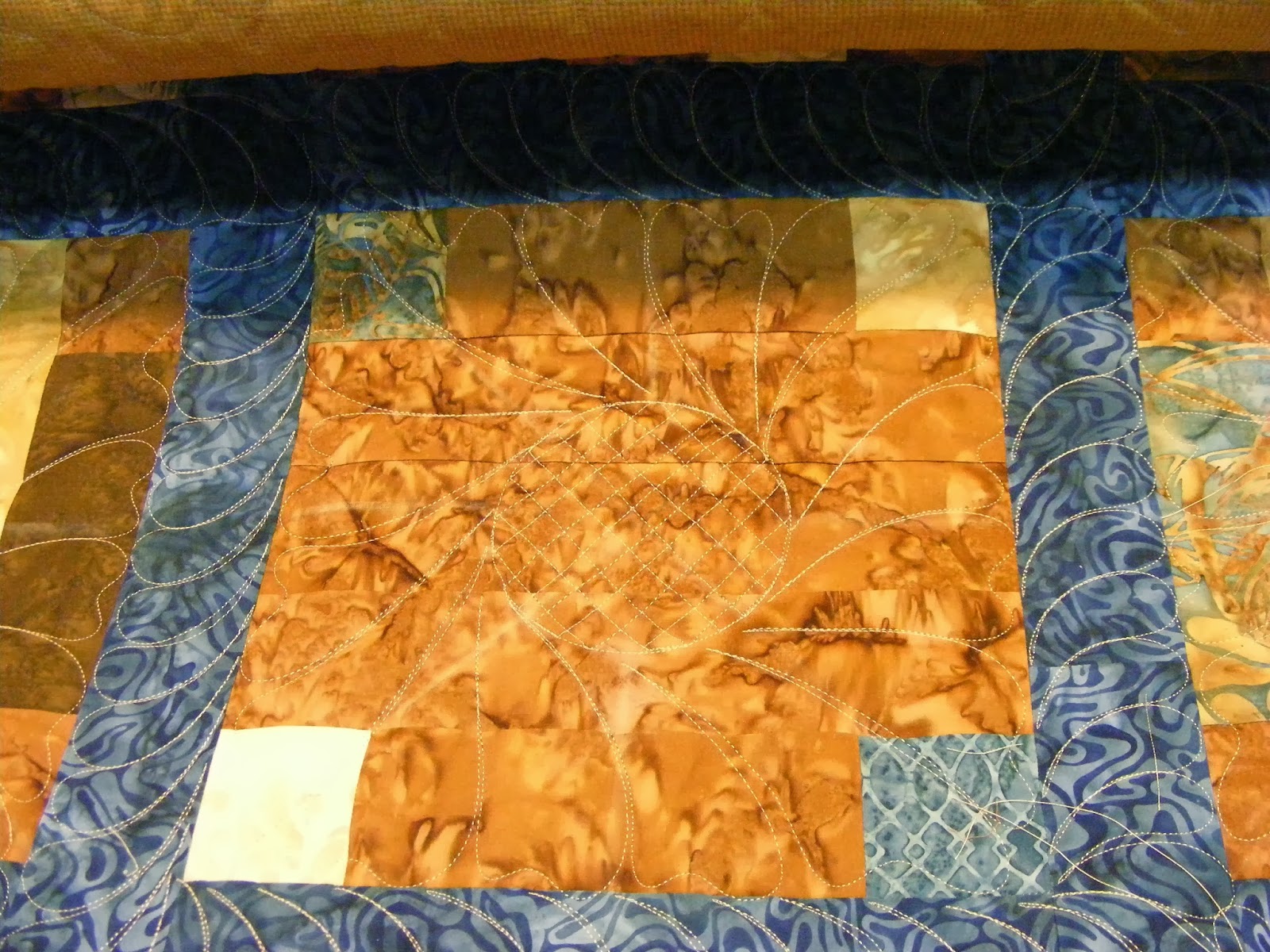
Yeah, finished quilting, forty six hours on a longarm and lots of time thinking and drawing.  The idea was to merge the design of the quilt top and the quilting into one design.  In person the quilting shows up so well, but the lighting for the photo didn't show it off well.   It took 46 hours to quilt on the longarm with 3 1/2 hours of ripping for one motif that was not centered correctly.  It was the last marked and quilted.


Thursday, November 14, 2013

A border idea and Shirley's vest

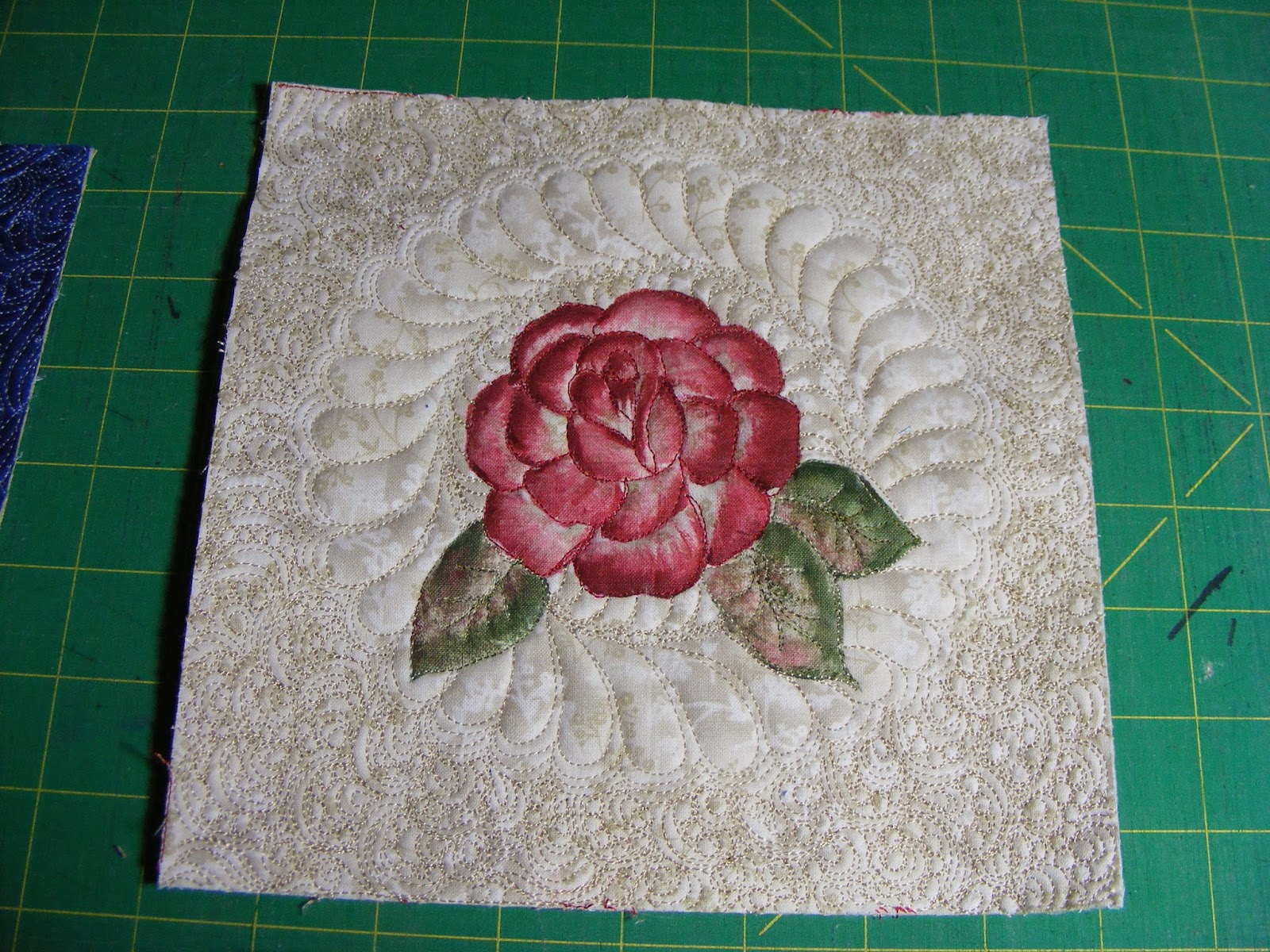
I quilted a quilt with a wide top and bottom border and narrow side borders  The overall look was Oriental and the blocks had dragons fussy cut.   I chose to do the feather on the outer border utilizing only part of the top and bottom border making the one side very irregular with the feathers.  Then I  filled in the rest of the border with clam shells that a friend called "dragon's scales".


Shirley's vest is finished and ready for her Birthday delivery.  The silver thread on a black denim looking fabric is stunning.

Saturday, November 2, 2013

Miniature quilts--Wholecloth

The Art Council sells  art work made on 8" canvases.  Quilting wisely is included and appreciated as art by them and I do a canvas each year.  Last year I was asked if I wanted to do two but didn't have time or an idea for a second one.  But this year I actually have ideas for 4 but only made two.

The miniature quilts are done but need to be bound and pulled over the canvas which is 1" thick.  The binding will cover the sides.  The binding frames the quilts.  The  blue thread, Tar Heel,  on the first glows in black light.  It is Glide which has several color that react in black light.


The last quilt is now about 11" and will be cut down a little.  The center is a doily made by my Mother.  I have quilted it and will give it to my brother.

Monday, October 21, 2013

What I have been working on

My sister bought a wonderful leather square with a design she liked.  We used it as the basis for a tote bag.  The leather piece was actually used as a pocket.  The strap hanging down on the left is for the hidden zippered pocket under the top flap.  That zipper and the hardware that lets the strap adjust in size were rescued from a kid's backpack.  There is even a zipped pocket inside a zipped pocket inside the tote.  The back has a slide in pocket that I find handy for stuffing hand outs and other non valuable items.


The local quilt group, the River Valley Stitchers, wanted a  lesson on bindings particularly on non square corners.   Elaine has two wonderful table runners that will be used for the lesson.


 Those great corners in the quilting  on the fill in triangles were accomplished with a ruler that had a 90 degree angle.


I took Angela Walter's Dot to Dot class.  The leaf is the first place I applied what I had learned.


Saturday, October 5, 2013

Pacific Rim Tablerunner

The Pacific Rim company has made a line of fabric that will make monies for Veterans medical care.  The quilt shop, Thimble N Thread in Richland Center WI has joined with them to sell these fabrics and are in the process of making  the kits and making samples.

I was given one of the table runners and told I could just do my thing.  The owner imagined since I love feathers it would be filled with feathers.  No, not a feather in sight.   My mind thought a star theme would work well.  The quilting is secondary and not noticeable from across the room, just some of the texture. That of course depends on the angle you see it from. But the quilting does not take over.  It is those wonderful red stars that show up first.


My first thought was of concentric stars with micro quilting in between the stars.   I would basically turn the background a different color so that the stars would puff.   On the inside of the patchwork stars, I did an 8 point star using the patchwork as my guide points.


On the border, I learned never to use my ruler measuring from close to me to the other side.  You can't see the line well and have to peer over the whole quilt.  Start in the back and come forward.  I also learned it is faster to do all the lines first and then go back and fill in the wider spaces with the meandering.


While only straight lines, meandering and pebbles were used, it still looks complicated.   It was an honor to be part of the project

Thursday, October 3, 2013

Jane's quilt is done, well quilted

Jane's quilt is gigantic, 115" by about 85".  The quilting seems even across the whole quilt and it lays very flat.  It took 12 hours to quilt.  I couldn't get a photo of the whole quilt but the small view gives a good view of the quilting.


Sunday, September 29, 2013

Connecting Up Feathers in borders


How to get the angle of feathers so you can have a continuous feather border.


I had to do  ovals of feathers and the connecting of the feathers would show up if not perfect.


I do borders all the time that go around the quilt and connect them up so sometimes they are perfect and sometimes not.  So I set out to figure out how to do it consistently 

My thought was that I know the angle of my feathers is 45 degrees so why not mark that angle with chalk.  Of course my line is not straight it is a curve.  At the point where I want to start my feather, I put a line straight across the line of the stem no matter what angle it is at.  I want 90 degree angles


 You can see just below the feathers a chalk line forming 90 degree angles on the stem.  In the first feather on each side of the stem you can see the 45 degree line I made by dividing that 90 degree line in half  On the right side of the photo in the blue you can see a chalked line 90 degrees to the seam.  The seam was used as if it was the stem.  Again you can see the chalk mark in that first feather at the 45 degree angle..


The next photo shows a section where the feathers have been joined.  Can you find the join?  I'm not sure myself.

Thursday, September 19, 2013

The DWR is quilted


The stop watch says a little over 27 hours to quilt  I did forget to turn it on a couple of times.  I used 21 class M bobbins with very fine Glide thread.    The greatest amount of time was the procrastinating before  putting it on the machine to quilt.

My goals in quilting:  I wanted the quilting on the rings to show that they intertwined and I wanted the birds to puff.  


To that end, I thought maybe feathered rings, one clockwise and the next, counterclockwise would do it.  But yes it was a challenge to keep clockwise and counterclockwise straight especially on the ends of the quilt on the partial rings.  I chalked C and CO in the blocks to help me.   The first row took 5 hours to quilt setting up the pattern of the rings.   I understand now why the DWR's that I see don't even quilt the rings letting them puff or do a simple non intertwining pattern.  The bulk in the seams can be a problem.  I was very careful when ironing my seams to spread out the bulk as much as possible.                                                  


McTavishing would make the background flat to puff the birds.  But I have been doing that for about 8 years so I included feathers and spirals in the McTavishing to give it my own signature.  


The quilt top was a challenge to piece, my first curved pieced quilt.  I did a tablerunner to try it to see if I could even piece this top.  Then it was used to test the quilting.  Now  I have to learn to bind that irregular outside edge.  The tablerunner will be the trial for that too. 

 The color on the photo below is a little more true.


Tuesday, September 17, 2013

My first post.

A little about me

My name is Deb.   I am a quilter.  I think in another life I was an efficiency manager somewhere.  I like to solve problems.  I make discoveries as I quilt of how to do things easier and how to make them look better.

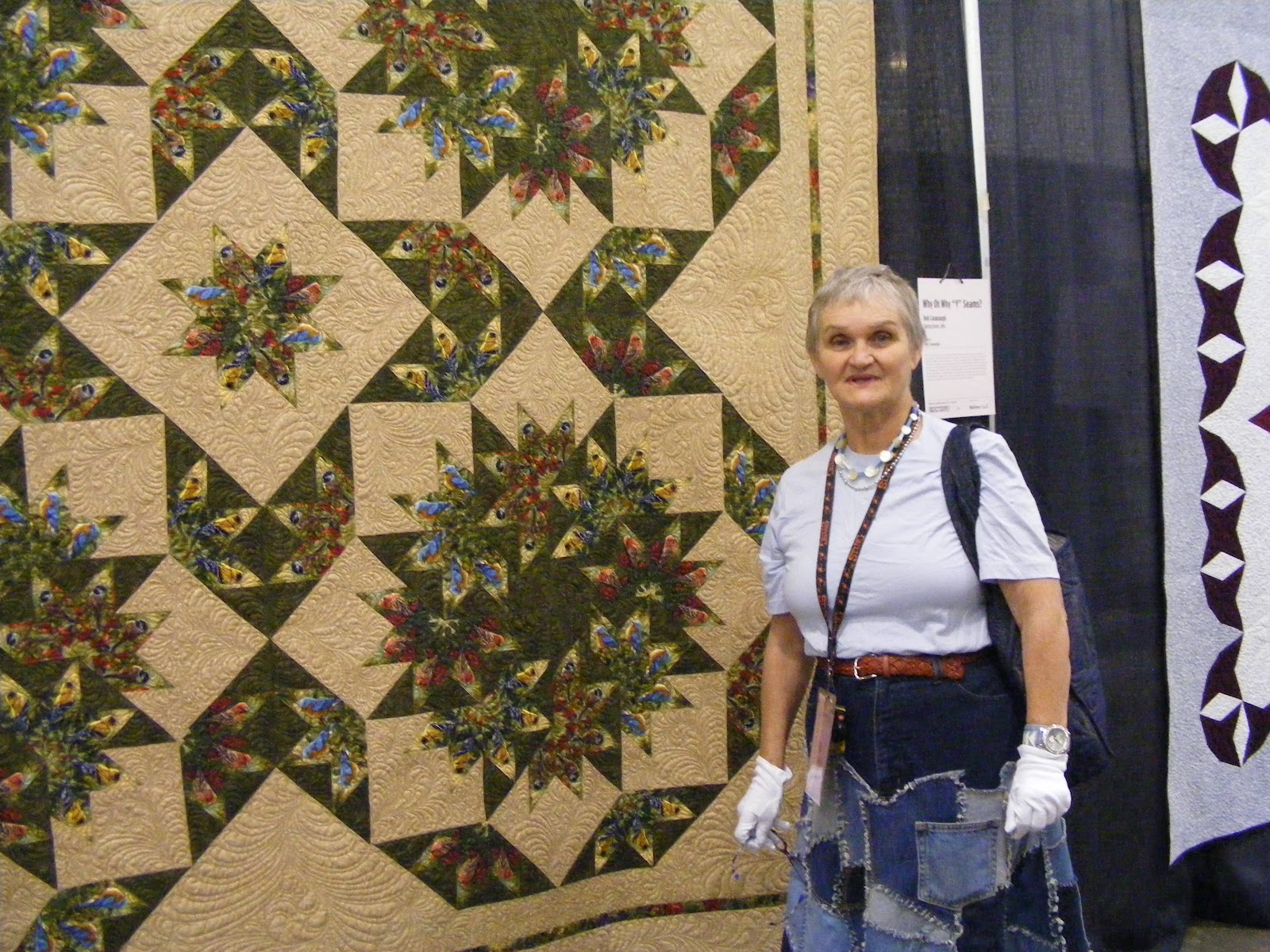
My current obsession is a repeat of how I started out, with quilted clothing.  Here in Wisconsin we are cold for 9 months of the year.  Vests and jackets are a great addition to a wardrobe and quilted or patchworked is just plain fun to wear.  The photo is me at the Madison Expo next to my quilt.  The skirt is made from bluejeans, the tote is quilted and the watch band is patchwork.


The first of the jackets and vests  shows a patchwork one that is at years old and one of the new jackets.

 The second photo show a vest using patches from denim and laces.  It was a great way to test some of those designs that came with my machine.  The denim vest has the pattern showing better on the lining than the denim outside but oh well, the outer color is better for me to wear.
 The purple vest is from fabric given to me by Kathleen, a friend.  It is actually the backside of the fabric.  She challenged me to have it made up into something by our local group meeting 10 days away.  The "right" side of the fabric was purple and metallic gold.

 The rose vest matches a quilt.  The blue/purple vest is a snow dyed fabric that I tried out a new design on.


In my blog, I am hoping to share what I am working on, what I am learning and discovering.

Tips on making quilted clothing

As I said, my current obsession is making vests and jackets.  This is what I have learned:

 I have discovered it is better to do the quilting on rectangles.  I mark the outline of my pattern  with chalk then add and inch outside of that line.  I quilt out to include that extra inch.  After all is quilted, I wash the rectangles.  Then I cut out my pattern pieces.  In this way, I know the exact size my garment will turn out after I have shrunk it up  and that it will be that same size after I have wash it.


This is one of the rectangles that will make the fronts of a vest  In the middle of the circles, you can see blank space.  That is the waste area of the neckline. My favorite batting is wool.  I am told silk is also wonderful but have not tried it yet.  Wool stays soft and drapes.  I am told that also applies to Silk.  Polyester batting will not drape as well and is not as comfortable to wear.